

Mainstreaming Popular Participation in Transitional Justice: Lessons from Multilateral, State and Civil Society Actors in The Gambia and Somalia
Statements on the need for popular participation are increasingly common in international and national transitional justice policy and literature, yet little guidance is available on how to put participation into practice. Based on empirical research in The Gambia and Somalia and with multilateral actors supporting transitional justice in Africa, this research report examines what participation looks like and provides actionable recommendations for enabling participation in a more meaningful way....

Mainstreaming Popular Participation in Transitional Justice
Based on their research in The Gambia and Somalia and with multilateral actors in Africa, our panellists share insights and recommendations for enabling meaningful participation by victims and survivors, communities affected by violence, and the broader population in formal and non-formal transitional justice measures.
Panellists:
Jasmina Brankovic, Senior Research Specialist, Centre for the Study of Violence and Reconciliation
Lena Houma, Programme Manager, Women in Liberation and Leadership
Farhia...

Maximising Popular Participation in Transitional Justice in Africa: A Guidance Paper for Multilateral Actors
Multilateral actors are increasingly interested in supporting transitional justice processes that maximise popular participation, especially by victims/survivors of violence and communities most affected by human rights abuses. Looking at the African context, this guidance paper outlines practical strategies for multilateral actors to mainstream participation in transitional justice processes, including...

Multilateral Actors and Support for Popular Participation in African Transitional Justice
This policy brief provides actionable recommendations for representatives of international and regional institutions, donor governments, private foundations, faith-based institutions, INGOs and other multilateral actors on mainstreaming participation in their transitional justice interventions.
Covering formal, state-led measures and non-formal, civil society-led measures, this guidance promotes transitional...

Les acteurs multilatéraux et le soutien à la participation populaire dans la justice transitionnelle africaine
Cette note politique fournit des recommandations concrètes aux représentants des institutions internationales et régionales, aux gouvernements donateurs, aux fondations privées, aux institutions confessionnelles, aux ONGI et aux autres acteurs multilatéraux sur l'intégration de la participation dans leurs interventions en matière de justice transitionnelle.
Couvrant les mesures formelles prises par...

الجهات الفاعلة المتعددة الأطراف ودعم المشاركة الشعبية في العدالة الانتقالية الأفريقية
يقدم موجز السياسات هذا توصيات قابلة للتنفيذ لممثلي
المؤسسات الدولية والإقليمية، والحكومات المانحة،
والمؤسسات الخاصة، والمؤسسات الدينية، والمنظمات
غير الحكومية الدولية، وغيرها من الجهات الفاعلة متعددة
الأطراف بشأن تعميم المشاركة في تدخلاتها في مجال
العدالة الانتقالية.
ويغطي هذا التوجيه التدابير الرسمية التي تقودها الدولة
والتدابير غير الرسمية التي يقودها المجتمع المدني، ويعزز
عمليات العدالة الانتقالية...
Enabling Popular Participation in Transitional Justice in Somalia
Given the country's increasing stability, transitional justice has become an option for addressing the violence and gross human rights violations that have marked Somalia's history from the colonial period to the present. Experiences in other African countries over the past three decades show that transitional justice processes are more likely to be effective if they are rooted in popular participation, particularly of victims/survivors and communities affected by violence.
This study explores emerging...

Somali Federal and State Interior Ministries: How to Enable Popular Participation in Transitional Justice
After years of conflict and instability, Somalia is entering a period where transitional justice is possible. Three decades of experience in Africa shows that transitional justice processes are more likely to be effective if they are rooted in popular participation, particularly of victims/survivors and communities affected by violence.
While the Somali government has not yet launched a truth commission, prosecutions, reparations or other formal mechanisms usually associated with dealing with the...

Wasaaradaha Arrimaha Gudaha ee Federaalka iyo Dowlad-goboleedyada Soomaaliya: Sida Loo Suurtagelin Karo Ka Qaybgalka Dadweynaha ee Cadaaladda Xilliga Kala-guurka
Sanado badan oo colaado iyo xasillooni-darro ah kadib, Soomaaliya waxay galeysaa xilli ay suuragal tahay in cadaaladda xilliga kala-guurka la hirgeliyo. Khibrad soddon sano oo Afrika ah waxa ay muujineysaa in geeddi-socodka cadaaladda xilliga kala-guurka uu u badan yahay inuu noqdo mid guuleysta haddii uu salka ku hayo ka qaybgalka shacabka, gaar ahaan dhibbanayaasha iyo bulshooyinka ay colaaduhu saameeyeen.
Inkastoo dowlada Soomaaliya aysan weli dhisin guddi runta, sidoo kalena aanay sameynin maxkamadeyn,...

Transitional Justice in The Gambia: Enabling Popular Participation
This research report examines the level of popular participation in The Gambia's transitional justice process to date and provides recommendations for ensuring more meaningful participation going forward. It begins with an overview of both formal and non-formal measures in The Gambia, before analyzing in detail the dynamics of participation in the formal measure of the Truth, Reconciliation, and Reparations Commission (TRRC) and in non-formal measures, particularly Listening Circles established by...

The Gambian Government and Popular Participation in Post-TRRC Transitional Justice
The government of Gambia has committed to implementing the recommendations of the Truth, Reconciliation, and Reparations Commission (TRRC) through further transitional justice measures. Three decades of experience in Africa show that a transitional justice process as a whole is more likely to be effective if it is rooted in popular participation, particularly of victims/survivors and communities affected by violence.
This policy brief is written for the Steering Committee leading the implementation...

The African Union and Member States: How to Mainstream Participation in Transitional Justice
The 2019 African Union Transitional Justice Policy (AUTJP) advances a unique transitional justice approach based on the principles of national and local ownership, African shared values, inclusiveness, equity and non-discrimination. These principles highlight the importance of popular participation and provide a framework for mainstreaming participation in a meaningful way.
This policy brief outlines how the AUTJP provides for participation, explains the value of participation, and identifies key...

L'Union africaine et ses États membres: Comment intégrer la participation à la justice transitionnelle
La Politique de justice transitionnelle de l'Union africaine (PJTUA) de 2019 propose une approche unique de la justice transitionnelle fondée sur les principes de l'appropriation nationale et locale, des valeurs africaines partagées, de l'inclusivité, de l'équité et de la non-discrimination. Ces principes soulignent l'importance de la participation populaire et fournissent un cadre pour intégrer la participation de manière significative.
Cette note d'information explique comment la PJTUA prévoit...
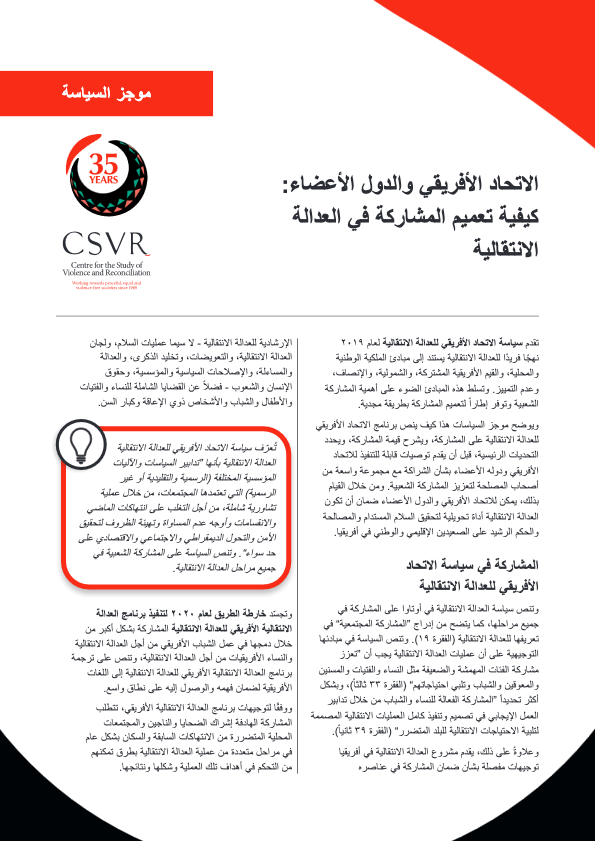
الاتحاد الأفريقي والدول الأعضاء: كيفية تعميم المشاركة في العدالة الانتقالية
تقدم سياسة الاتحاد الأفريقي للعدالة الانتقالية لعام 2019 African Union Transitional Justice Policy (AUTJP)نهجًا فريدًا للعدالة الانتقالية يستند إلى مبادئ الملكية الوطنية والمحلية، والقيم الأفريقية المشتركة، والشمولية، والإنصاف، وعدم التمييز. وتسلط هذه المبادئ الضوء على أهمية المشاركة الشعبية وتوفر إطاراً لتعميم المشاركة بطريقة مجدية.
ويوضح موجز السياسات هذا كيف ينص برنامج الاتحاد الأفريقي للعدالة الانتقالية على المشاركة، ويشرح قيمة المشاركة، ويحدد التحديات الرئيسية، قبل أن يقدم توصيات قابلة للتنفيذ...


