Criminal Justice Tag

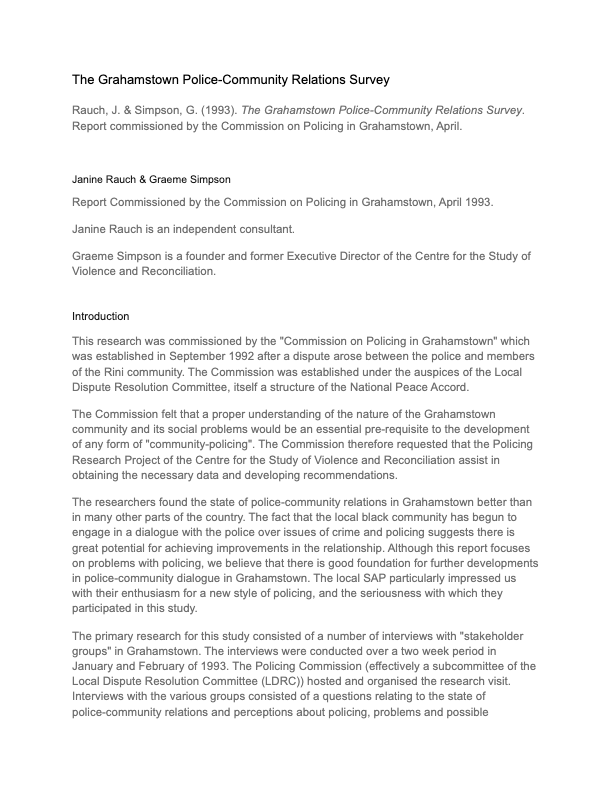
This essay draws on the concept of embedded policing to argue that community safety rather than community policing must be achieved through the proliferation of civil ordering and injury prevention programmes. This should be coordinated by a Community Safety Forum within which community policing is one of the components of ordering: a Community Policing Charter is proposed, specifying police service standards and methods of implementation. Finally, it is argued that bottom-up initiatives will not succeed unless they hook into a workable national accountability system that creates "circles of power" through which individuals and communities achieve and maintain political leverage.

Victor Nell and Gerald Williamson
25 Aug 1993

This paper analyzes police-community relations in South Africa. It focuses on the way that South Africa's political context has impacted these relations. It also looks at the ways in which the police are understood both by communities and by the police themselves, and how this impacts on expectations of the police. The paper draws on international experiences to provide recommendations for improving police-community relations.

Etienne Marais
04 Aug 1993

The bulk of the police reforms introduced in the 1990-91 period in South Africa were initiated by the government or the South African Police itself. The new rhetoric of police reform, centring on the concept of "community-supported policing," continues to dominate the public debate about the transition and the longer term reform agenda. This paper examines the relationship between state and civil society in the process of police reform in the transitional period in South Africa.

Janine Rauch
02 Aug 1993

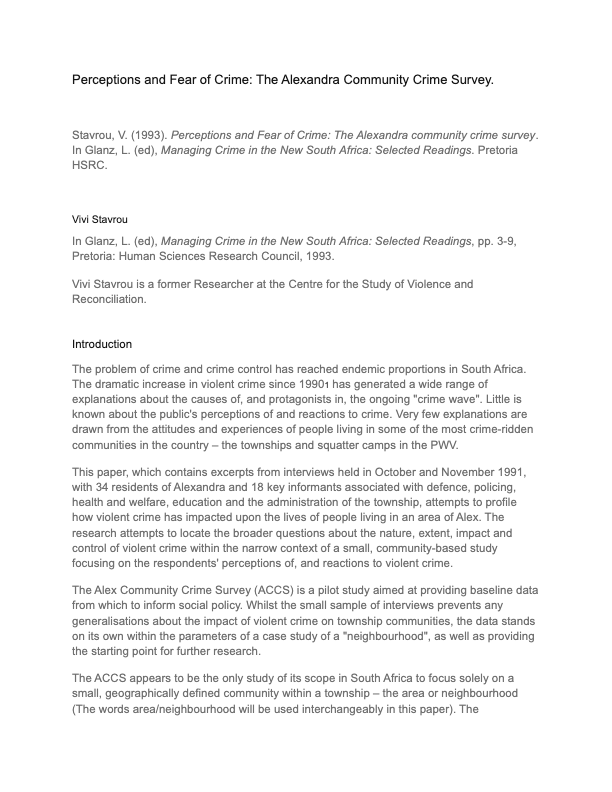
This paper draws on interviews held in October and November 1991 with 34 residents of Alexandra and 18 key informants associated with defence, policing, health and welfare, education and the administration of the township. The paper attempts to profile how violent crime has impacted upon the lives of people living in an area of Alexandra, Gauteng. The research locates the broader questions about the nature, extent, impact and control of violent crime within the narrow context of a small, community-based study focusing on the respondents' perceptions of, and reactions to violent crime.

Vivi Stavrou
02 Feb 1993

The involuntary confinement of the mentally ill describes the legal process by which a person is imprisoned for an indeterminate period not because they have committed any criminal act but because they are allegedly ill. This paper raises a series of concerns with this practice, and its implementation in South Africa. It concludes by offering a series of legal and legislative reforms concerning the practice. 

Nicholas Haysom, Martin Strous and Lloyd Vogelman
01 Feb 1993
Translate »

You can support CSVR’s work on justice, peace, and human rights

Close Welcome Bar